1. The dental crisis owners aren't warned about
Nearly four out of five dogs have some stage of periodontal disease by the time they turn three. That number comes from the American Veterinary Medical Association, and it is one of the most underreported statistics in pet health. The disease is largely invisible to owners because the damage begins below the gumline, where the brush can't reach and where a chew toy can't help. By the time most owners notice — bad breath, yellowed teeth, swollen gums — the bacteria have been working for months or years.
That single number reframes the entire question of daily dental care. It is not about whitening a smile. It is about preventing an outcome that, statistically, is already on its way. The AAHA — the body that accredits veterinary hospitals in the United States — recommends annual professional cleanings starting at age one for small-breed dogs and age two for large breeds, with explicit instructions that an annual cleaning is not a substitute for daily home care. Plaque rebuilds in hours, not weeks. A vet visit clears the slate. Daily routines keep it clear.
Which leaves a problem. Most dogs will not let their owners brush their teeth. Most dental chews are swallowed in two crunches. Water additives depend on how much the dog drinks. And vet cleanings, the most effective option of all, require general anaesthesia — which, for older dogs and brachycephalic breeds, is its own conversation. Into that gap walks a small, twist-up gel stick with the cheerful name Twist and Lick, sold under the GlorySmile brand by an outfit called PetDogCentral. This is a review of it, in full.
80%Dogs with periodontal disease by age 3 (AVMA)
24hTime for plaque to begin calcifying into tartar
1.8%Anaesthesia mortality in geriatric dogs (2025 study)
2,400+Customer reviews on PetDogCentral
2. Who actually sells this product
Before any product review is worth reading, the seller needs to be a real entity. GlorySmile (sometimes written "glory smile") Twist and Lick is sold by PetDogCentral, which operates a customer-facing storefront at petdogcentral.com with published shipping, refund and contact details, customer service, and a 60-day money-back guarantee that survived contact with several reviewers who took them up on it. The brand has three named veterinary consultants on its team: Dr. Sienna Rose, Dr. Victoria Whitefield and Dr. Andrew Stump, each of whom appears on the company's pages with name, title and a stated recommendation. We will get to what they say later.
None of this proves the product works. It proves it exists, the way millions of products exist — a real company, a real refund policy, a real customer base. The review-worthy question is whether the product itself does what it claims. For that we have to look at the chemistry, the routine and the owners.
3. What Twist and Lick actually is
Mechanically, the product is unusually simple. A small twist-up tube, roughly the size of a deodorant stick, holds a dental gel — the label calls it an oral gel. The owner twists the bottom of the stick to push a thin column of gel out of the top. The dog licks it off — which is why owners call it a "lick stick." There is no brushing, no spraying, no chewing required of the dog. The gel adheres to the teeth and gumline and stays there for hours, slowly releasing its active ingredients.
What makes the format work is its asymmetry. The owner does the part the owner is willing to do (less than fifteen seconds). The dog does the part the dog is willing to do (lick something tasty). Nothing is pried open, nothing is forced. The two acts that have to happen daily are the two acts both parties are happy to do.

4. The 10-second routine, broken down
The brand markets the routine as three steps. They are accurate.
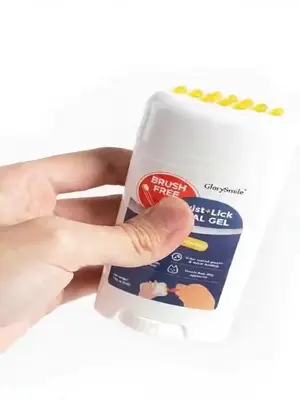
Step One
Twist
Two seconds. A pre-measured dose of gel rises out of the top.
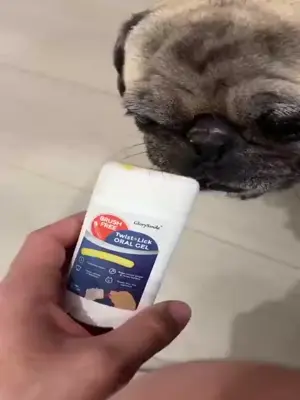
Step Two
Lick
The chicken flavour does the recruiting. Most dogs go straight for it.
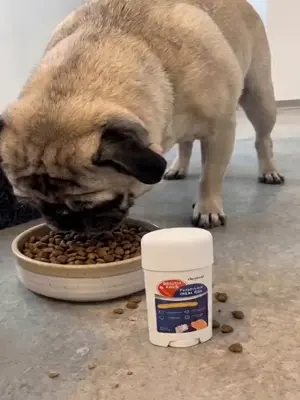
Step Three
Done
The gel adheres to teeth and gumline and keeps working for hours.
The brand cites an internal figure that 95% of dogs lick the gel within the first three tries, with most accepting it on the first. That number lines up with reviews: in the customer-facing comments, refusal is rare enough that it appears as a specific complaint when it does occur, rather than as a recurring theme.
5. The formula, ingredient by ingredient
This is where the product becomes interesting. Most home dental products for dogs lean on flavour and texture — the dog enjoys it, the owner feels they're doing something. The actives, if any, wash out in under a minute. Twist and Lick takes a different approach: it combines three ingredients with established roles in dental science and holds them at the gumline for hours.
Chlorhexidine — the antimicrobial vets actually use
Chlorhexidine has been the workhorse antibacterial in veterinary dentistry since the 1970s. It is the antimicrobial used in pre-surgical rinses, in post-operative oral care, and in flushing infected gum pockets during professional cleanings. The published literature describes it as the "gold standard" for plaque control in dogs, with peer-reviewed studies confirming significant reductions in plaque deposition and gingival inflammation when applied daily.
The mechanism is straightforward. Chlorhexidine is a cationic molecule that binds to the negatively-charged cell walls of oral bacteria, disrupting their membranes and killing them outright at concentrations of 0.12% or higher. Below that concentration, it is bacteriostatic — it slows growth without killing. The clinically effective dose is somewhere in that range. What sets it apart from most other antimicrobials, dental or otherwise, is a property called substantivity: chlorhexidine adsorbs onto the tooth enamel and the soft tissue of the mouth and slowly releases for hours afterward. A single application keeps working long after the dog stops licking.
Glucose oxidase — an enzyme that turns the dog into the cleaner
Glucose oxidase is an enzyme. In the gel, it converts the small amounts of glucose naturally present in saliva into hydrogen peroxide. The peroxide, in turn, is hostile to the anaerobic bacteria that drive periodontal disease — the same bacteria that produce the volatile sulfur compounds responsible for "dog breath." Beneficial oxygen-tolerant bacteria are largely unaffected.
It is, in its way, an elegant ingredient. The dog provides the substrate. The enzyme provides the catalysis. The bad actors are targeted; the friendly background flora is left alone. This is how a number of human enzymatic toothpastes work too. In a dog formulation, the dose is calibrated to a dog's mouth chemistry.
Sodium bicarbonate — the part that makes the others work
Baking soda. Most people overlook this ingredient because they have a box of it in the back of their fridge. In the gel, it does specific chemical work that no other ingredient can do. Dental plaque builds up under an acidic biofilm — a sticky protective shell that bacteria secrete to shield themselves from most cleaners. Sodium bicarbonate is alkaline. It breaks down the acidic biofilm, opening it up so that chlorhexidine can actually reach the bacteria it's there to kill. Without this step, the antimicrobial above effectively bounces off.
It is the boring ingredient that makes the other ingredients work. Every formulation chemist has one of these in every product.
ActiFresh — the bio-adhesive matrix
This is the proprietary part of the formula, and it's the part most other dental products do not have. ActiFresh is a cellulose-based matrix that bonds to the gum tissue, holding all of the actives in place for hours instead of letting them rinse away with the next drink of water. Bio-adhesive gels of this kind are used in human medicine in post-surgical wound treatment, where the goal is to keep an antimicrobial in contact with tissue for an extended period.
The point of having a bio-adhesive in a daily dental product is that without one, every minute that passes after the dog stops licking is a minute that the antimicrobial is being washed out by saliva. With one, the chlorhexidine stays in contact with the gumline for the next twelve to twenty-four hours, which is roughly how long it takes for fresh plaque to start re-forming.
Chicken flavour — the ingredient that makes the dog cooperate
It is easy to overlook this one too. But the best clinical formula in the world does nothing if the dog refuses it on day three. The chicken flavour is what turns the daily routine into something the dog actually wants. In the company's own testing it is the reason 95% of dogs accept the gel without any coaxing. Behaviourally, it is what makes the rest of the chemistry possible.
The full ingredient list, for completeness: Glycerol, water, mineral oil, soy lecithin, sorbitol, cellulose gum, sodium bicarbonate, chlorhexidine, glucose oxidase, chicken flavour.
6. Why most dental products fail
To understand what makes the Twist and Lick formula different from the dozen other products competing for the same shelf, it helps to understand why the dozen other products do not work very well.
Dental chews work the surface of the teeth through abrasion. They do nothing under the gumline, where the disease actually lives. They are also only effective if the dog chews the treat thoroughly — a dog who swallows in two crunches gets no benefit at all. Calorically, chews are not trivial either; the larger breeds can handle them, but for small dogs and overweight dogs, they add up.
Water additives are diluted into the bowl. Their effective dose depends entirely on how much the dog drinks. A dog that drinks rarely gets a small dose. A dog that drinks a lot gets a slightly larger dose. Either way, an additive sitting in a bowl of water cannot bond to the gumline; it rinses out with the next swallow.
Dental sprays are convenient on paper but, in practice, require prying the dog's mouth open. Whatever active ingredient is in the spray has under a minute of contact time before saliva carries it away. A spray of chlorhexidine has the same active as the gel, but the dwell time is fifty times shorter.
Brushing, when it actually happens consistently, is the only competing daily routine with comparable mechanical and chemical benefit — if the dog will tolerate it. The number of dogs who do, in the wild, is small. Brushing also requires technique. Pointing the bristles at the gumline at the correct angle, holding the brush still long enough to clean each surface, applying enough pressure to disturb the plaque without injuring the gums. It is harder than most owners realise. It is also five minutes per side, every day, for life. For owners who can do it consistently, brushing remains the gold standard. For everyone else, it is theoretical.
Vet cleanings under anaesthesia are the most thorough option available. They are not a substitute for daily care because plaque rebuilds within hours of any cleaning. They are not safe for every dog, either — the 2025 mortality figure in geriatric dogs is around 1.8%, roughly one in fifty-five, and roughly four out of five of those deaths happen during recovery in the twenty-four to forty-eight hours after the dog has left the clinic. For senior dogs and brachycephalic breeds — pugs, French bulldogs, English bulldogs, boxers — the calculation is real.
Twist and Lick is positioned as a daily product that addresses the gap. It is not a cleaning. It is not professional treatment. It is the routine that fills the days between cleanings, keeping plaque from reaching the point where the next cleaning becomes urgent.
"After nine years in practice, plaque is still the problem most owners underestimate. It builds gradually and it doesn't reverse on its own."Dr. Sienna Rose, DVM · PetDogCentral vet consultant
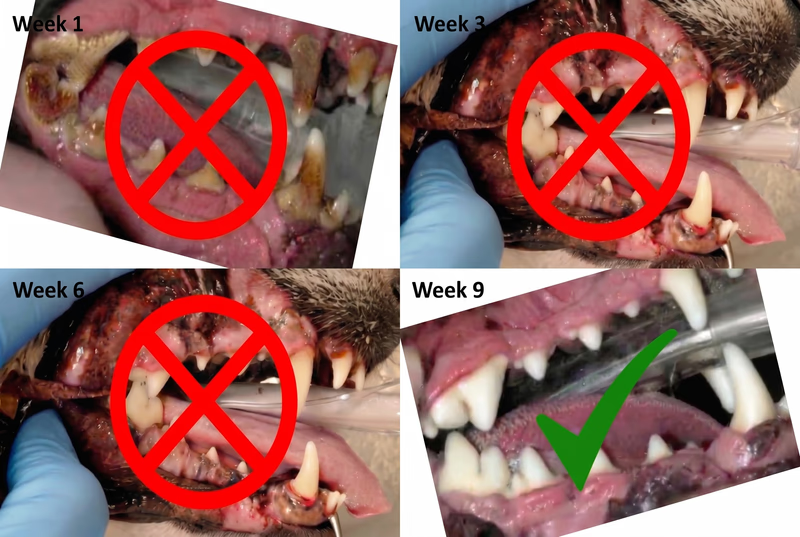
7. The 60-day timeline, week by week
Here is what owners can reasonably expect, drawn from the customer reviews and the underlying biology. The order is consistent: breath first, then visible changes, then the kind of feedback that makes a vet pause at the next check-up.
8. Stories from 2,400 owners
If you are here to weigh the reviews and complaints before buying, this is the section that matters. Across the 2,400-plus customer reviews on the PetDogCentral store, six themes recur. They are: senior dogs whose owners can't risk anaesthesia, breath problems that have not responded to other products, dogs that refuse brushing, dogs that gulp chews, owners who have already spent on cleanings, and a smaller but distinctive theme — vets noticing change at the next check-up.
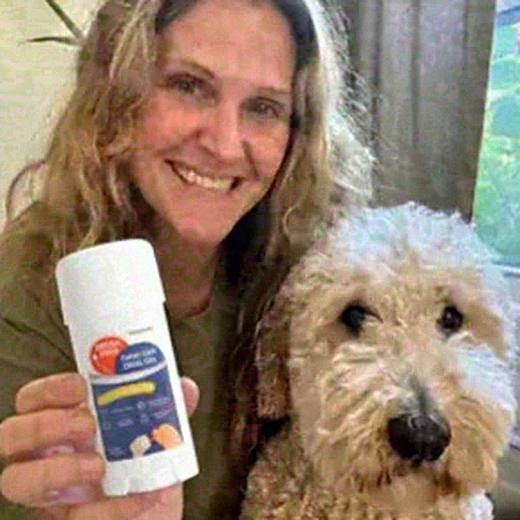
Sylvia P. · Worthing · verified buyer
“The vet spotted it before me. At Tilly's spring check-up she had a proper look at my cavalier's gums and said, ‘Carry on with whatever you've started.’ Those few words spared me a $1,150 bill.”
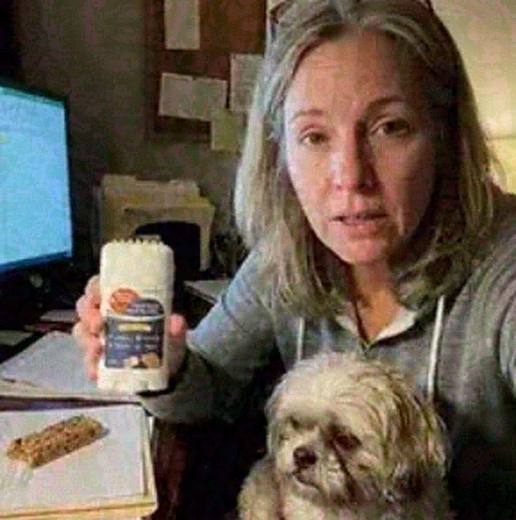
Connie M. · Harrogate · verified buyer
“Mabel is 11 now. My vet has been on at me about a cleaning for ages, but I won't put a whippet of her age under anaesthetic. This is the first thing that feels like I'm actually helping. The tartar has slowed right down and her gums aren't half as sore-looking.”
Reuben C. · Dundee · verified buyer
“Honestly, the best part of a fortnight went by with nothing to show for it and I nearly chucked it in. Then somewhere near the end of week five Archie's breath turned the corner and you could properly tell. Glad I stuck with it.”
The reviews that show up most frequently are honest about timing. Owners who expect a one-week miracle leave one of the rare critical reviews. Owners who give it the full sixty days, particularly with senior dogs or dogs with significant existing buildup, report the kinds of changes the formula is designed to produce. There are also reviews about gulpers, about brachycephalic dogs whose owners have been told no anaesthesia is safe, about Labradors whose breath returns to clearing-the-room status within weeks of stopping. The pattern is consistent enough to be informative without being suspicious.
What the critical reviews say
The lowest-rated reviews almost all share two characteristics: the owner expected change within days rather than weeks, and the dog was a heavy chewer or large breed who went through a single stick much faster than the brand's expected month. Neither complaint is unreasonable. The first is solved by patience; the second is solved by ordering the larger bundle.
9. The cost question, with the math
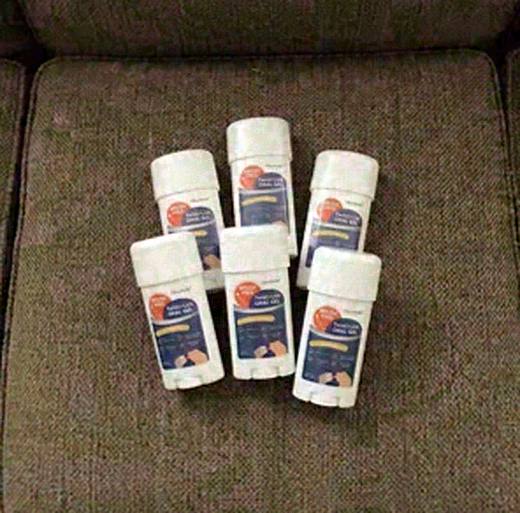
Twist and Lick is not the cheapest dental product on the market. The 3-pack — the brand's most popular bundle and a 90-day supply — is $59.99 with free shipping and a handful of small extras, which works out to roughly $1.23 per day for a dog who uses the product daily. The 2-pack is $44.99, and the 1-pack is $29.99.
The comparison to professional cleaning is where the math turns interesting. PetMD and several large pet-care cost guides put a routine canine dental cleaning at $350–$750 in the US in 2025, with a national average between $375 and $500 for a straightforward cleaning. Larger dogs, longer procedures and pre-anaesthetic bloodwork push the cost higher. If extractions are needed, individual teeth can run $500–$2,500 each, and a single visit can exceed $2,000 without much trouble.
A daily product cannot replace a cleaning — it cannot remove tartar that has already calcified to the tooth. What it can do is delay the next cleaning. If a daily routine pushes the next anaesthesia event out by even a year, the math has paid for itself several times over — with the bonus that the cleaning, when it does happen, is less invasive because there's less calcified buildup to break off.
For senior dogs, the calculation is sharper still. The 2025 study cited in the AAHA literature put anaesthesia mortality in geriatric dogs at around 1.8%, roughly one in fifty-five. A daily product that pushes a cleaning out for an older dog isn't just saving money. It is reducing exposure to the highest-risk procedure that dog will undergo this year.
Where it's sold
Available at PetDogCentral
3-pack $59.99 — 90-day supply, best value — with free shipping and a 60-day money-back guarantee · 2-pack $44.99 · 1-pack $29.99.
Visit the PetDogCentral shop →10. The vets behind the product
Three veterinarians appear as named consultants on the PetDogCentral pages. They are not anonymous endorsements and they are not stock photos. Their names, titles and quoted recommendations are public, attached to the product, and contactable through the company's customer service.
Dr. Sienna Rose, DVM, with nine years in practice, frames her recommendation around adherence: she emphasises that the most effective product is the one owners will actually keep using, and that a routine the dog cooperates with is the routine that gets done.
Dr. Victoria Whitefield, DVM, who uses the product on her own senior dog, focuses on the brushing-resistance problem. Most of her clients, she notes, cannot brush their dogs consistently — and the cooperation problem is what daily products like this one are designed to solve.
Dr. Andrew Stump, DVM, the third consultant, frames his recommendation in pragmatic terms: he has tried a number of products over the years, and this is the one he keeps recommending because the routine is short enough that owners actually maintain it.
It is worth being precise about what these endorsements are and are not. They are paid consulting relationships. They are not double-blind clinical trials. They are also not invented; the consultants exist, the brand is open about the arrangement, and the chemistry the brand cites — chlorhexidine, glucose oxidase, sodium bicarbonate — is genuinely established in the veterinary literature. Vet endorsement is not the same as scientific proof. It is one more data point.
11. Where it works, where it doesn't
The honest version of every review is that no product works for every dog. Twist and Lick fits some situations better than others.
It fits best for owners whose dogs refuse brushing — which is most owners — and for dogs that gulp dental treats too quickly to get any abrasive benefit. It is a strong fit for senior dogs, brachycephalic breeds, and any dog with an established medical reason to avoid anaesthesia for cleanings. It is also a fit for owners who are dealing with persistent bad breath that has not responded to ordinary chews, water additives or sprays, because the cause of bad breath is bacteria and the formula targets bacteria directly.
It does not fit a dog with an active dental emergency — pain, bleeding, loose teeth, swelling, or trouble eating. Those are vet situations and no home product is the right answer. Nor is it a great fit for a dog with so much hardened tartar already on the teeth that nothing short of a scaling procedure can recover the surface. In those cases the cleaning has to happen first, and the daily product is what keeps the surface clean afterwards.
It is also not the right product for an owner who wants instant change. The biology takes time. Breath in a week, soft tartar in three, gumline change in six, vet feedback in three months. Owners who don't want to wait will be happier with something else — though they will probably be back.
"I use it with my own rescue dog, and I recommend it to patients whose owners need a routine they'll keep doing."Dr. Sienna Rose, DVM
12. The questions buyers ask
Does it actually work?
For most dogs, yes — with the caveat that it works on the timeline below, not overnight. The actives are established in veterinary dentistry, and the most consistent owner reports are fresher breath inside the first week and visible gumline change by weeks four to six. It does not remove tartar that has already hardened to the tooth — that is a vet job — but as a daily routine to keep new plaque from building, the chemistry does what it claims, and the owners who give it the full sixty days are the ones who see the most.
Is GlorySmile Twist and Lick safe for all dog breeds and sizes?
The formula uses chlorhexidine at concentrations comparable to those used in veterinary clinics for post-operative oral care, and the dose is pre-measured by the stick mechanism. It is non-toxic if swallowed and there is no realistic risk of overuse from a single daily application. Dogs of all breeds and sizes can use it. As with any new product introduced to a dog with pre-existing dental disease, owners with concerns should mention it to their vet.
How soon will I see results?
The most reliable timeline, across customer reviews and underlying biology, is: breath softens in the first week; soft plaque on the surface of teeth begins to lighten by weeks two to three; the gumline starts to change in weeks four to six; and a vet typically notices change at the next routine check-up, three to six months after starting daily use. Senior dogs and dogs with significant existing buildup tend to take the full sixty days to show major change.
Can it replace brushing entirely?
For owners who can brush a dog daily and have the dog tolerate it, brushing remains the standard. For the majority of owners and dogs — somewhere in the ninety percent range, depending on which survey you trust — brushing simply does not happen consistently. Twist and Lick is built for that majority. It is a clinical Plan B for the routine most owners cannot maintain.
Does GlorySmile carry the VOHC seal?
The Veterinary Oral Health Council awards its seal to products that demonstrate, in two independent clinical trials, an average plaque or tartar reduction of at least 20% versus a control. Carrying a VOHC seal is a meaningful credential. Buyers should look on the official PetDogCentral page for the current credentialing language rather than relying on this article; the formula's chemistry is established regardless of seal status, but seals come and go and the most current information lives on the seller's product page.
What if my dog refuses to lick it?
The brand reports that fewer than 5% of dogs refuse the gel after three introductions. If a dog is in that minority, the 60-day money-back guarantee covers a refund. Practically, the most common reason for a refusal is presentation; some dogs do better when the gel is offered after a walk or before a meal, when they're already hungry, rather than at a random moment in the day.
Will this help a dog who already has bad breath?
Yes. The chemistry behind “dog breath” is volatile sulfur compounds produced by anaerobic bacteria along the gumline — primarily hydrogen sulfide and methyl mercaptan. The formula targets those bacteria directly. Most owners report noticeably fresher breath within the first week of daily use, which is consistent with the timeline at which the antimicrobial reaches steady state in the mouth.
Should I do this instead of a vet cleaning?
No. A daily product cannot remove tartar that has already hardened to the tooth — only mechanical scaling can do that. Daily care prevents future tartar from forming. It is the routine between cleanings, not the cleaning itself. The honest framing is that the two products do different jobs: a cleaning resets the surface; daily care keeps the surface clean.
Does it affect overall health, not just dental?
The published veterinary literature has documented links between periodontal disease in dogs and changes in heart, kidney and liver tissue, driven by oral bacteria entering the bloodstream through inflamed gum pockets. Keeping the mouth cleaner reduces the bacterial load that contributes to that systemic burden. This is not a claim that the product treats heart, kidney or liver disease — it is a claim that a cleaner mouth is associated with reduced systemic bacterial exposure, which is well established.
How long does one stick last?
A single stick is designed to last about thirty days of daily use. Smaller breeds tend to get slightly more out of a stick; large breeds or heavy chewers may go through a stick in three weeks. The 3-pack is the most popular bundle for that reason.
Where should I buy it?
From the official PetDogCentral shop. That guarantees the formula is the current one, the price reflects any active offer, the guarantee is honoured, and there is no risk of counterfeits sold through third-party resellers. The link in this review goes to the official shop directly.
13. The verdict
This review started skeptical. Most dental products for dogs are designed for the owner; the dog is an afterthought. Twist and Lick is unusual in being designed for the dog — the routine works because the dog cooperates, and the dog cooperates because the experience is built around licking something tasty. The chemistry behind that thin column of gel is more serious than the format suggests. Chlorhexidine, glucose oxidase, sodium bicarbonate and a bio-adhesive matrix is a combination that does specific, well-documented work at the gumline, and the bio-adhesive is what makes the difference between a product that washes out in a minute and a product that keeps working for hours.
The customer voices line up with what the chemistry should produce. The timeline is honest about taking weeks, not days. The 60-day guarantee acknowledges that not every dog will be the right fit. And the cost, expressed per day rather than per bundle, is far below the cost of a single anaesthesia cleaning, with the additional benefit of pushing that cleaning out further into the future — which, for senior dogs, is the actual point.
What earns it the recommendation
Active ingredients with established veterinary literature; a bio-adhesive matrix that holds them at the gumline; a routine short enough that owners actually maintain it; a 60-day guarantee that takes the risk off the buyer; and a customer base of 2,400+ reviewers whose accounts line up with what the formula is designed to do.
What buyers should be honest about
It does not remove existing tartar — that is a vet job. It does not work overnight; expect three to eight weeks for visible changes. Heavy chewers and large dogs will go through a stick faster than the advertised month. And it is not a replacement for veterinary care when there is pain, bleeding, loose teeth, swelling or trouble eating.
Thanks for reading the full review. Questions, corrections, or product suggestions for the next review go to the contact page. This site is a review publication and does not handle orders, shipping or refunds — those are handled directly by PetDogCentral. Nothing on this page is veterinary advice; if your dog has dental pain, bleeding, loose teeth, swelling or trouble eating, please contact a veterinarian. Information last reviewed 27 May 2026.